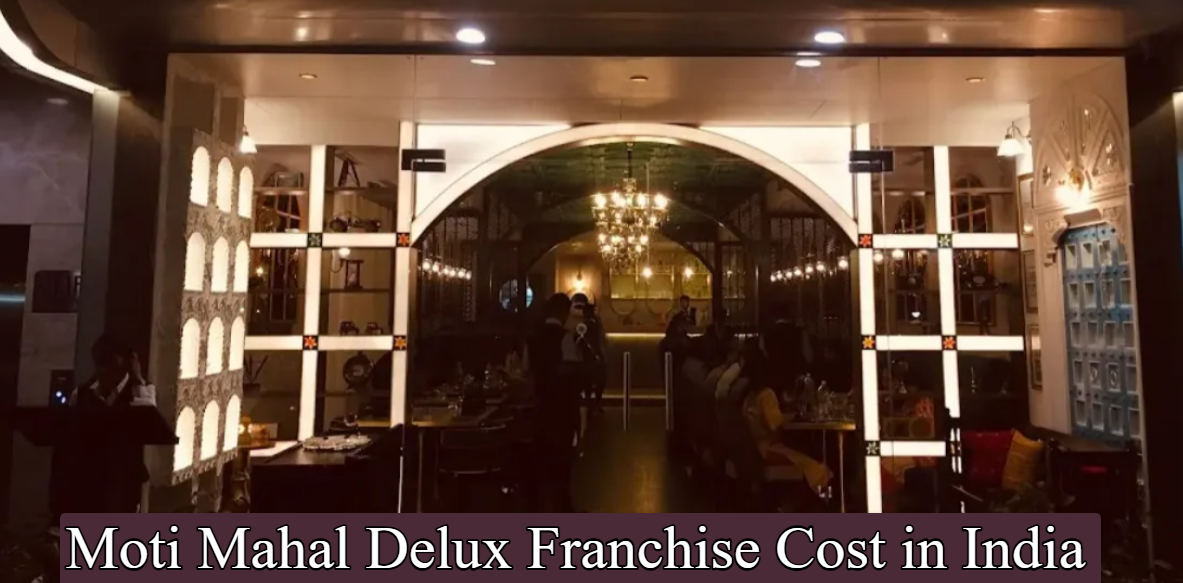
If you’re contemplating opening a restaurant franchise in India The renowned Moti Mahal brand–famous for its North Indian & tandoori cuisine including the renowned butter chicken–offers an opportunity that is credible. Since food service is highly competitive and risky and a well-established brand name and a well-tested model reduces risk. In this blog I’ll guide your through the franchising model used by Moti Mahal Delux, the estimated cost, ROI goals and eligibility requirements as well as application procedures and useful information to help you determine if this franchise is suitable for your objectives.
about Moti Mahal Delux
Moti Mahal has a storied tradition: first established in the twenty-first century Kundan Lal Gujral in Peshawar and later Delhi The brand was the first to pioneer the tandoori cooking method and also Butter Chicken as a dish. The current brand (Moti Mahal Delux Management Service Pvt. Ltd.) has expanded through its franchises and stores owned by the company, in India as well as overseas.
Due to this tradition this brand has an excellent reputation among consumers and has a high position, which could benefit franchisees. On the other hand it also means that the cost of investment will be higher than food kiosks with low-end prices and the operations will require an efficient execution.
Franchise Model-What exactly does appear to be?
Formats & Ownership Models
In its own disclosures and franchise listing websites, Moti Mahal offers multiple outlets: kiosks/quick-service, casual-dine, fine-dine and cloud kitchen, and perhaps food-truck or “trail” models.
As for ownership structures: According to a franchise website, there is the “FOCM (Franchise Owned Company Managed)” model that is proposed in which the franchisee is the owner of their own outlet (invests in the establishment) however day-to-day operations are handled by the management of the company. Some sources even provide “FOFO (Franchise owned Franchisee Operated)” to refer to certain franchise formats. If they do provide FOCM, it could lower the operational burden for the franchisee, but could result in different royalty/revenue sharing. Be sure to know the exact model of your particular city or format.
Assistance from the Franchisor
The company’s website says it is supportive of support for site selection as well as interior design and fitting guidelines, kitchen and staff training, tie-ups with supply chains as well as branding and marketing assistance. E.g. The Moti Mahal website claims they aid in managing vendor and staff recruitment, as well as training menu planning, as well as the licensing of food and liquor.
This is crucial, especially when you’re making the move into the food industry in the very first instance.
franchise Cost Breakdown and Investment Estimate
Since investment rates vary significantly according to type (kiosk or fine-dining) and also by place (metro vs the tier-2/3) I’ve provided the ranges that I have based on reliable sources, as well as practical assumptions.
The most common cost components
- Franchise Fee: one-time cost due to the brand for permission to use their brand name and support and training.
- Interior and fit-out: cost of building a venue furniture and decor signage.
- Kitchen equipment & installation: ovens, tandoor, HVAC, refrigeration, display counters.
- Initial inventory and items: raw materials, packaging and consumables.
- Working capital include: salaries, utility bills rent buffer for the initial months.
- Licences/permissions: FSSAI, local municipality, liquor licence (if required), fire/safety.
- Marketing and launch costs Opening promotions including digital marketing, signs.
Estimated Investment Ranges
From the website of the brand and other sources:
- A kiosk or smaller size (food-court or mall) cost: Rs20-30 lakh.
- Casual dining: Investment approximately 40-60 thousands (depending on the size and location).
- A high-end, gourmet flagship style that can be a significant investment of from Rs70 lakh to one million (or even more) with premium interiors, big dimension.
- Franchise Fee: reported as 7-12 lakh (depending on the format) in certain sources.
- Royalty Fee: often cited as ranging from 6-8% of sales for various kinds of formats.
Summary: Total investment generally is between 20 lakh (for small-sized formats) to Rs1 croreplus (for large fine-dine formats).
Revenue, Margins & ROI Expectations
Payback and Profitability
A franchise’s listing states that food prices are approximately 30-35 percent (for dine-in formats) and an estimated ROI (break-even) between 14 and 24 months for some models. Another source states ROI “within 12- 18 months” for certain types. The listing also includes the profit margin of 35-40%..
Practical Scenario
If you decide to invest 50 lakh in a medium-sized restaurant. If you can earn an annual income in the range of Rs1.2 million (i.e. approximately Rs10 million each month) and the net margin after the rent, wages and utilities, the cost of goods percent (Rs12 lakh annually). This would result in a payback of 4-5 years. However, if you make better numbers, like Rs1.8 crore, with a net margin of less than 15 percent (Rs27 lakh) and payback is less than 2 years. The location and the execution are important.
The stated ROI of 12-18 months might be applicable to metro areas with high footfall that have solid brand recognition as well as efficient operation. Locations with lower traffic may require long (24-36 months and more). Plan for slower times.
Eligibility and Ideal Profile of a Franchisee
To be considered as a candidate for an Moti Mahal franchise common requirements comprise:
- Capacity to finance the working capital and investment buffer.
- Possibility of securing a suitable site (size is dependent on the format, e.g., 400-600 sq.ft for kiosks and 1500-3000 sq.ft for informal dining; greater for fine dining).
- The ability or experience to oversee the operations of a restaurant (staffing and service, as well as quality). Even if the brand is supportive of operations, you have to commit.
- The commitment to maintain brand standards for service, food and hygiene.
- Knowledge of the market: Understanding the local F&B dynamics Rent levels, customer behavior.
- Ability to work with brand’s SOPs, training programs and menus as well as supply chain.
Experience in a restaurant is an beneficial, but not always necessary. Some advertisements state “no experience in F&B experience is needed” however franchisees must demonstrate their business acumen.
How to Apply for an Moti Mahal franchise
This is a step-by-step guideline to follow:
- Research and Visit Visit the current Moti Mahal outlets in your region or city. Evaluate concept, menu, footfall, pricing.
- contact Franchise Team: Use the official website to fill out an inquiry or franchise application form. Include the following basic information including your name, profile, your proposed location, city or location, and investment capacity.
- Get franchise information Pack (FIM): The brand will provide specific information that includes cost breakdown, formats options, territories rights support package agreements, and to terms.
- Site Proposal and Approval: Find possible sites. Provide lease/ownership proof, location information as well as local demographics. Brand will review and confirm.
- Agreement and payment After approval of the site as well as background check, you’ll be required to sign an agreement with the franchisor. You will pay the franchise fee as well as an the initial deposit.
- Store Setup and Training Brands support you with design/fit-out, kitchen installations and staff training (culinary and service).
- Launch and Operations Implement a the grand opening plan for launch and coordinate with marketing for the brand start operations and monitor KPIs.
- Support and Review on a regular basis This includes support for menu changes as well as marketing campaigns as well as supply chain and operational audits. Review monthly performance and adjust the strategy.
Practical Tips and Cautions
- The location is crucial The strength of a brand cannot make up for inadequate visibility, a lack of foot traffic, or excessive rent. Consider the rent in a realistic way and calculate break-even according to them.
- Budget prudently Consider slow sales for the first year. Create a buffer of working capital for 6-12 months of operation.
- Clear the way for marketing and royalty fees Be sure to know the fees that you must pay on a regular basis (royalty and marketing fund) you are required to pay.
- Examine clauses for renewal or exit of agreements What happens after the period (5-9 year)? Are there exclusive rights? What happens if you have to quit earlier?
- Contact existing franchisees If possible talk to existing Moti Mahal franchisees in order to better understand the actual challenges such as staffing, food cost escalation as well as supply delays and brand support.
- Providing consistent results If you’re a traditional brand, consumers expect top quality and consistent service. A poor execution can undermine the local brand’s credibility.
- Delivery and take-away component: In the present market deliveries and online channels (aggregators) are important. Check that your format and location are in line with orders for delivery.
- Mechanisms that the model (FOCM and FOFO): If the model is “Company-Managed” (FOCM) you might have a lower operational burden however you could have different terms and conditions for profit sharing. Find out the level of control you are in and what your role is.
- Local fit and competition: North Indian cuisine is popular and your unique selling point is brand and atmosphere, service, and value. Research local competitors.
Last Thoughts
The Moti Mahal Delux franchise can be an attractive opportunity for entrepreneurs who is looking to get into the restaurant industry with solid brand backing. The investment ranges from 20-30 thousand for smaller sizes and rising to Rs 70 lakh to Rs 1 crore plus for larger sizes The financial commitment is huge, however, the opportunity is huge should it be executed correctly. The estimated ROI/payback will be twelve to 24 months in ideal conditions however, you must consider a period of 24 to 36 months in a moderately-sized setting.
 1
1