 11
Russia’s path to socialism began with the collapse of an autocratic, war-exhausted empire. The Tsarist state, backward in agriculture and unevenly industrialized, was discredited by defeat in World War I, mass casualties, and food shortages. In February 1917 (March in the Gregorian calendar), strikes and mutinies in Petrograd forced Nicholas II to abdicate. Power was then split between a liberal-led Provisional Government and the workers’ and soldiers’ soviets.
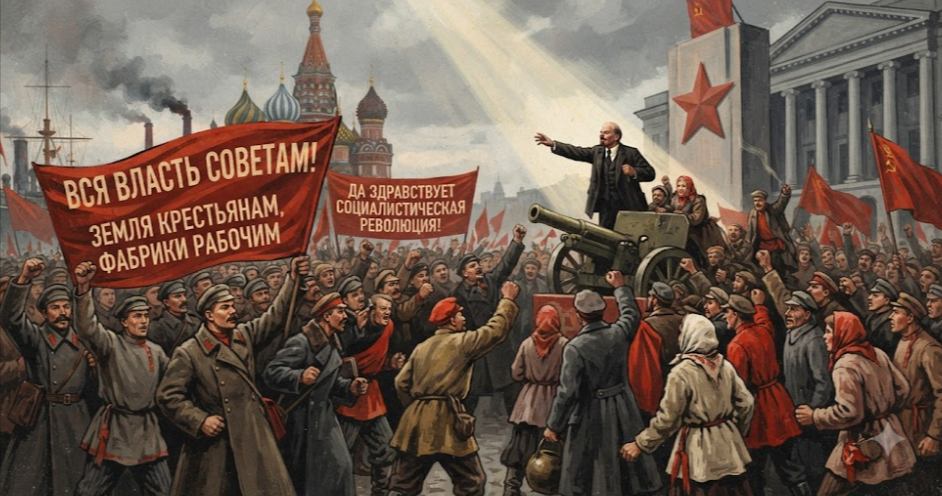
The Provisional Government kept fighting the war and delayed land reform, which eroded its support. Lenin’s Bolsheviks capitalized with the slogan “Peace, Land, Bread” and “All power to the Soviets,” winning majorities in the major city soviets. In October 1917 (November, Gregorian), they seized power in Petrograd and formed the Council of People’s Commissars under Lenin.
The new government moved quickly: it pulled Russia out of the war (Brest-Litovsk, 1918), abolished private landownership, nationalized banks and large industry, and dissolved the Constituent Assembly in favor of soviet rule. It then fought a brutal Civil War (1918-22) against the Whites and other opponents, during which it adopted War Communism, with grain requisitioning, state control of industry, and the Red Terror. The Bolsheviks won, but the economy collapsed, famine struck, and uprisings like Kronstadt forced a change of course.
Lenin’s New Economic Policy (1921-28) allowed limited private trade and replaced requisitioning with a tax, while the state held the key industries. The USSR was formally created in 1922. After Lenin’s death in 1924, Stalin won the succession struggle, abandoned NEP, and imposed rapid industrialization through Five-Year Plans and forced collectivization of farms, declaring in 1936 that socialism had been built.
The result was a one-party state with a planned economy, public ownership of the means of production, and major gains in literacy, urbanization, and industrial capacity, but at enormous human cost through famine, repression, and the purges. Historians continue to debate whether it realized socialism or distorted it, and whether Stalinism was an outgrowth of Bolshevism or a break from it.
Key takeaways
February Revolution. Strikes and bread riots in Petrograd turned into a mutiny of soldiers. Nicholas II abdicated in March (by the Gregorian calendar; “February” in the old Russian calendar). Power was shared uneasily between the Provisional Government (liberals and moderate socialists) and the Petrograd Soviet, a situation called “dual power.”
Why the Provisional Government failed. It kept fighting the war, delayed land reform, and postponed major decisions until a Constituent Assembly could meet. The failed summer offensive, the July Days unrest, and General Kornilov’s attempted coup in August further weakened it.
Lenin’s strategy. Returning in April, Lenin issued the April Theses, calling for no support for the Provisional Government, “All power to the Soviets,” and the slogan “Peace, Land, Bread.” The Bolsheviks won majorities in the Petrograd and Moscow soviets by autumn.
October Revolution (25 Oct / 7 Nov 1917). The Bolsheviks, through the Military Revolutionary Committee (organized by Trotsky), seized key points in Petrograd and the Winter Palace with little bloodshed. The Second Congress of Soviets approved the takeover and created a government, the Council of People’s Commissars (Sovnarkom), headed by Lenin.
Immediate decrees (1917-18)
Consolidating power
War Communism (1918-21)
During the Civil War, the state seized grain from peasants, banned private trade, rationed food, nationalized nearly all industry, and imposed labor discipline.
New Economic Policy (NEP, 1921-28)
After economic collapse and unrest, Lenin retreated: grain requisition was replaced by a tax, small private trade and businesses were allowed again, while the state kept the “commanding heights” (heavy industry, banking, foreign trade). The economy recovered.
Stalin’s “socialism in one country” (from late 1920s)
After Lenin’s death (1924) and a power struggle, Stalin ended NEP and launched Five-Year Plans (rapid state-led industrialization) and forced collectivization of agriculture. By 1936 a new constitution declared that socialism had been “basically built.”
Why did the revolution happen in Russia rather than an industrialized country?
Marx expected it in advanced capitalist states. Russia combined an exhausted war effort, a discredited regime, a land-hungry peasantry, and a militant urban working class, which made it the “weakest link” in Lenin’s view.
Was October 1917 a coup or a popular revolution?
Historians disagree. One view stresses a well-organized, minority-party seizure of power. The other stresses mass support in the soviets and among soldiers and workers, who wanted peace and land. Many scholars say it was both: a planned seizure that succeeded because of broad discontent.
Why do some sources say “February” and “October” while the dates look like March and November?
Russia used the Julian calendar until 1918, which ran 13 days behind the Gregorian one.
What is the difference between socialism and communism in Marxist-Leninist theory?
Socialism is the transitional stage with state ownership and the “dictatorship of the proletariat.” Communism is the stateless, classless end goal. The USSR claimed to have reached socialism but never communism.
Who were the Reds and the Whites?
Reds were the Bolsheviks and their supporters. Whites were a loose coalition of monarchists, liberals, and army officers, plus other anti-Bolshevik groups such as Greens (peasant armies) and nationalist movements.
Was the Soviet Union truly socialist?
It is debated. Supporters point to abolishing private ownership of the means of production, planned economy, and expanded education, healthcare, and women’s rights. Critics (including many socialists) argue it was a one-party dictatorship or “state capitalism” where workers had little real control.
Why did the Bolsheviks win the Civil War?
Centralized control, the Red Army’s organization under Trotsky, a compact territorial base with the main industrial and rail centers, peasant fear of a return of landlords under a White victory, and disunity among their opponents.
How many people died?
Estimates vary widely. The Civil War and associated famine and disease are commonly estimated to have caused several million deaths in total, with later collectivization and the purges adding millions more.
What happened to the revolution’s leaders?
Lenin died in 1924. Stalin outmaneuvered rivals, exiled Trotsky (assassinated in Mexico in 1940), and executed most of the Old Bolsheviks in the 1930s purges.