 11
11 Business networking across the Gulf is entering a new digital era. Professionals in Qatar, the UAE and Saudi Arabia increasingly expect communication and information sharing to be fast, convenient and mobile-friendly. One technology helping businesses meet that expectation is Near Field Communication, better known as NFC.
NFC allows compatible smartphones and devices to exchange information over a very short distance. While the technology is widely associated with contactless payments, its business applications now extend to digital business cards, customer engagement, hospitality, events and smart workplace experiences.
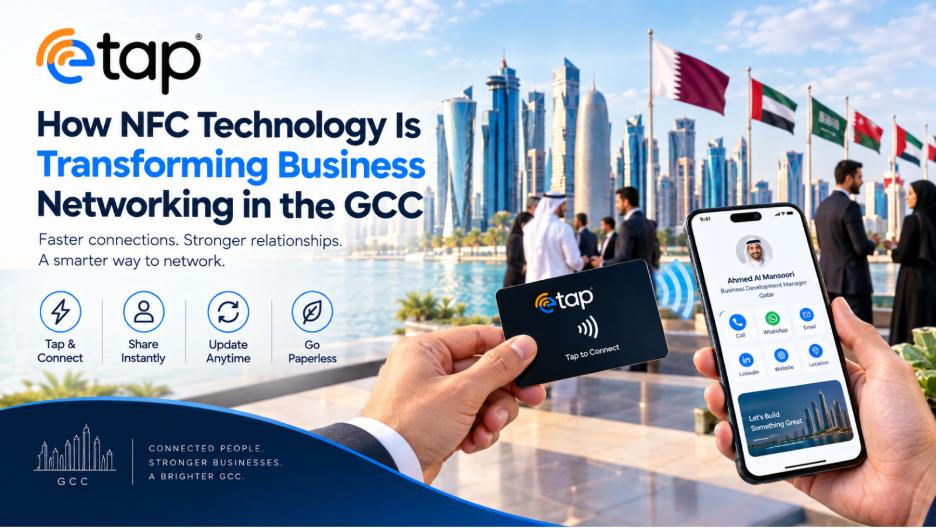
For professionals, one of the simplest applications is the NFC digital business card. Instead of relying entirely on printed contact details, a professional can use an NFC-enabled card to connect a prospect with a digital profile. A simple tap can open contact information, WhatsApp, LinkedIn, a company website, social media profiles, portfolios or appointment links.
This is particularly useful in the GCC, where exhibitions, conferences and business networking events bring together professionals from many industries. A person may meet dozens of prospects in a single day. Exchanging paper cards remains familiar, but it can create friction after the event. Cards can be misplaced, contact information can become outdated, and recipients may need to manually enter details into their phones.
NFC creates a more direct journey: tap, view, save and follow up.
The advantage is not simply speed. Digital information can be updated without changing the physical card. If an employee changes their job title, phone number or website, the online profile can be updated while the NFC card remains useful.
NFC also has applications beyond professional networking. Hotels can use contactless touchpoints to connect guests with digital services. Restaurants can provide menus, reservation pages or review links. Retailers can connect product displays to detailed information. Event organizers can use NFC for registration, digital exhibitor information and attendee engagement.
The technology therefore provides a bridge between physical environments and digital experiences.
There is also a sustainability consideration. Businesses that frequently print cards and information materials may be able to reduce unnecessary reprinting by moving frequently changing information into digital profiles. Qatar National Vision 2030 places environmental development alongside economic, social and human development, creating a wider context for businesses seeking more efficient and sustainable practices.
However, NFC should not be treated as a solution simply because it is new. Its value comes from how well it supports a real customer or business journey. A digital card should provide useful information, clear calls to action and an easy way for recipients to continue the relationship.
For sales professionals, an NFC profile can include product information and appointment links. For real estate agents, it can lead to current property listings. For consultants, it can provide a portfolio and booking page. For company executives, it can create a central professional identity.
This flexibility is one reason NFC is gaining attention as businesses modernize their networking processes.
In Qatar, businesses can explore these opportunities through local providers such as etap NFC Solutions, which offers NFC digital business cards and other contactless products for professional and commercial applications.
The future of GCC networking is unlikely to be completely physical or completely digital. Instead, successful businesses will increasingly combine the two. A physical card can create the first interaction, while a digital experience keeps the relationship moving.
For professionals who want to make networking faster, more flexible and easier to manage, NFC digital business card Qatar provides a practical way to turn a traditional introduction into a lasting digital connection.